- English
- Afrikaans
- שפה עברית
- Cymraeg
- беларускі
- Hrvatski
- Кыргыз тили
- Kurdî
- IsiXhosa
- Zulu
- Punjabi
- Somali
- O'zbek
- Հայերեն
- Sundanese
- Español
- Português
- русский
- Français
- 日本語
- Deutsch
- tiếng Việt
- Italiano
- Nederlands
- ภาษาไทย
- Polski
- 한국어
- Svenska
- Malay
- বাংলা ভাষার
- Dansk
- Suomi
- Pilipino
- Türkçe
- Gaeilge
- العربية
- Indonesia
- Norsk
- český
- ελληνικά
- український
- Javanese
- فارسی
- नेपाली
- Burmese
- ລາວ
- Қазақша
- Македонски
- Română
- Srpski језик
Early Vacuum Tubes High-Frequency Equipment Introduction
20 years ago,high-frequency power sources(commonly known as “high-frequency furnaces”)used for welding pipes and heat treatment in China were mainly equipment with electronic tubes(also known as “vacuum tubes”) as the main inverter components.The basic principle is shown in the following figure:
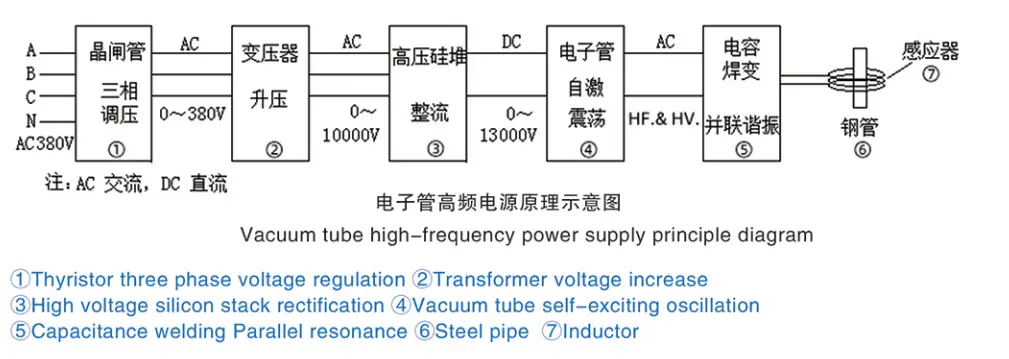
Normal industrial AC(three-phase four wires 380V/50HZ in China) is converted into adjustable AC ranging from 0 to 380V(frequency unchanged) through thyristor AC voltage regulator,and then stepped up to nearly 10000V high voltage(frequency unchanged) by a transformer,and then rectified by a high voltage rectifier circuit to tens of thousands high voltage DC,and then oscillated by vacuum tube to HF and HV current,and then through LC parallel resonance to amplify oscillating current,and after voltage reduction supply to inductor used for heating of steel pipes and other workpieces etc.
AC voltage regulation purpose is to adjust input and output power to meet working requirements,and when adjust voltage also needs to make the voltage stable to ensure equipment output power stability under certain operating conditions.
Due to the use of vacuum tube(high voltage small current components),voltage must be increased or can not output large power,but at the same time,in order to adapt to the small impedance of the inductor,it is necessary to further reduce the voltage.
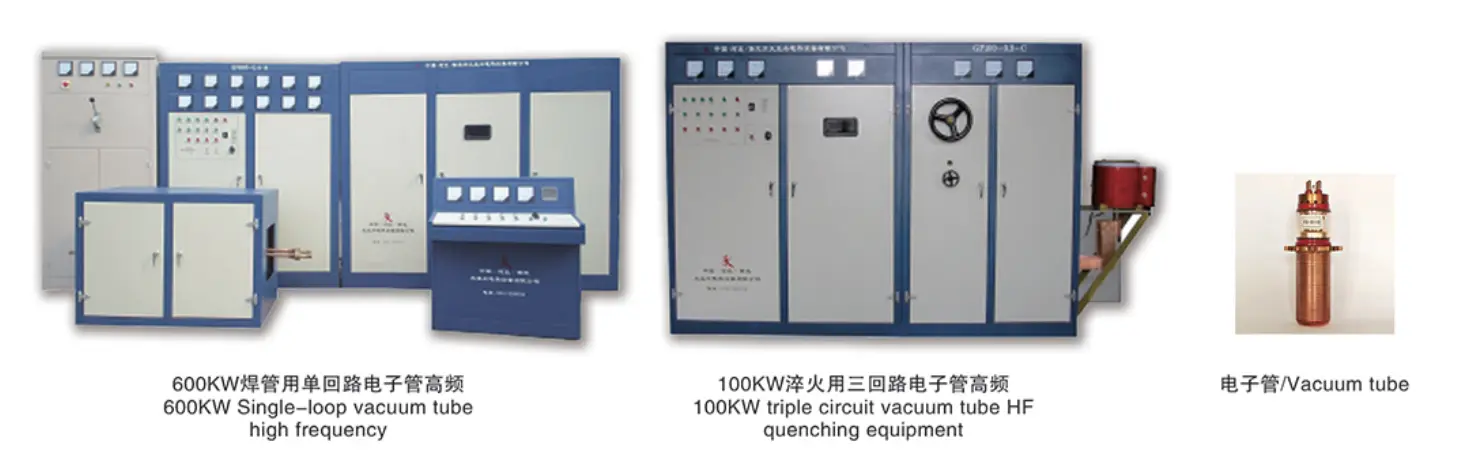
The below photos are 600KW single-loop vacuum tube high frequency and 100KW triple circuit vacuum tube HF quenching equipment.
In the pipe welding industry,there are still a small number of high frequency vacuum tubes,while in the fields such as quenching and brazing,high frequency vacuum tubes are still widely used.